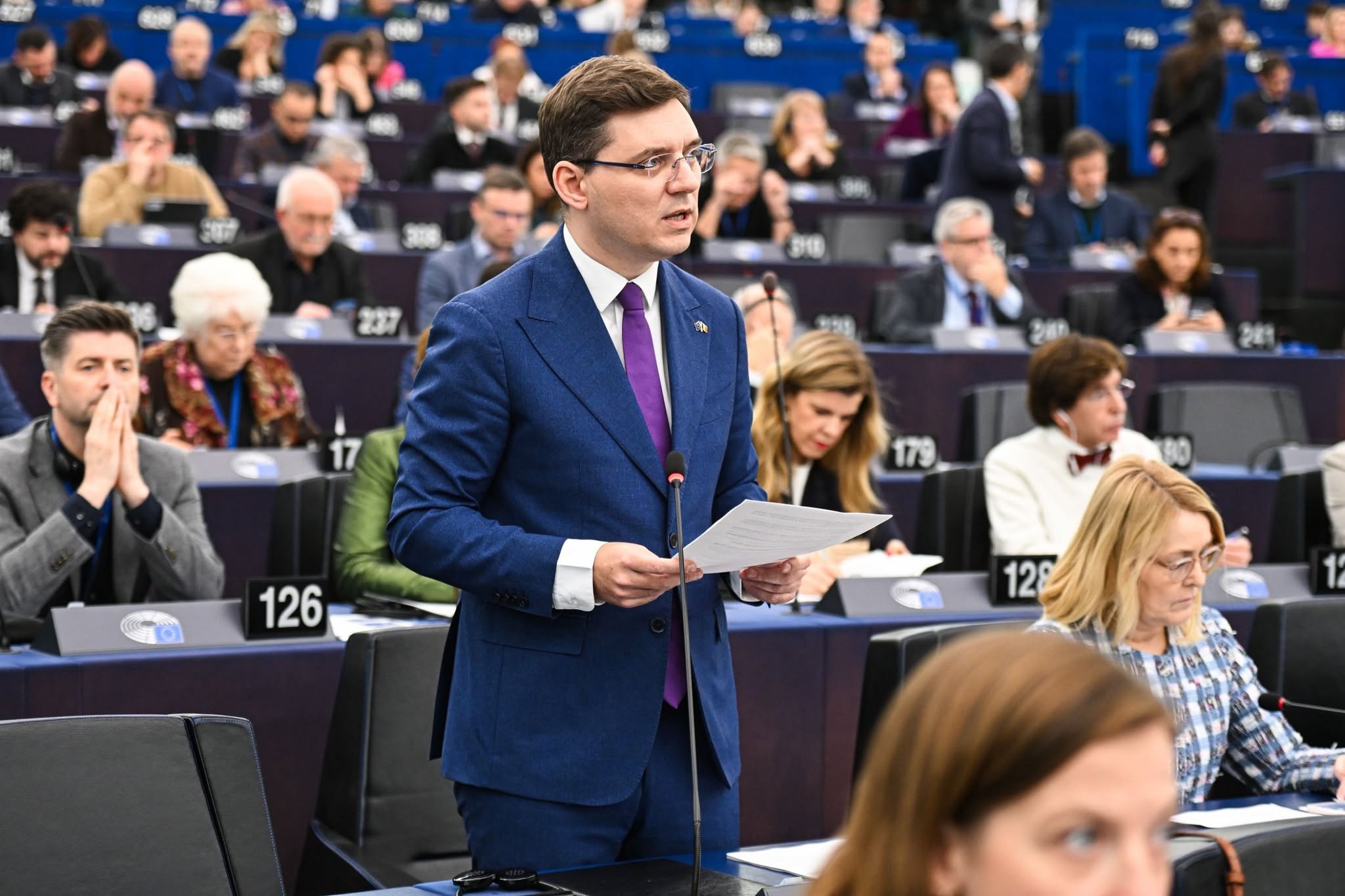
During the June plenary session of the European Parliament, the institution’s Vice-President, Victor Negrescu, who is responsible for relations with the Republic of Moldova, issued an appeal to strengthen the political and financial support provided to Chișinău in its process of joining the European Union.
“The Republic of Moldova is no longer just a neighboring country. It is part of our European family. In an extremely difficult regional context, Moldova has remained firmly committed to reforms and European values,” stated the Romanian MEP.
In his address, he emphasized that accession should not be reduced to mere technical chapters but must mean improving Moldovans’ daily lives: “For citizens, for children, for vulnerable families, for those in rural areas, Europe must also mean social protection, access to education, and basic services,” said the Vice-President of the European Parliament.
In this respect, Victor Negrescu called in the European Parliament for Moldova’s access to pre-accession funds within the EU’s next Multiannual Financial Framework and for including the country in the “Roam Like at Home” program. He also announced that the European Parliament would open a liaison office in Chișinău, an initiative he personally supported and which represents “both a symbolic and a practical step toward a real and constant European presence on the ground.”
His call came in the context of the European Parliament adopting a report recognizing the significant progress Moldova has made in aligning its domestic legislation with EU standards. The report urges the European Commission to step up its support for the pro-European government in Chișinău in meeting the EU’s accession requirements.
“Europe is not a distant dream. Europe is a certainty, and Moldova has its place here alongside us,” underlined Victor Negrescu.
In June, the Vice-President of the European Parliament undertook a visit to Moldova to participate in activities, events, and conferences dedicated to the country’s European path. Prior to traveling across the Prut River, Victor Negrescu met in Brussels with Moldovan Prime Minister Dorin Recean for an “open and pragmatic” discussion on Moldova’s European integration process.
He has consistently contributed to ensuring that Moldova benefits from substantial support and significant funding from the European Union, through successive amendments to the EU budget aimed at securing resources for development, children, cross-border projects with Romania, and the involvement of civil society, social partners, and the Moldovan diaspora, including those living in Romania.
“I have been the MEP of everyday people in Moldova. Politics has always come second for me,” he said, adding that during his discussions in Brussels he received “clear assurances” from Prime Minister Recean regarding respect for these priorities in future funding allocations.
In his capacity as Vice-President of the European Parliament responsible for relations with Moldova, Victor Negrescu reiterated his commitment to remain engaged to ensure that “European funds reach people, where they are truly needed.”
It is worth noting that, in addition to his political and institutional efforts, the Romanian MEP has actively supported the projects of Save the Children Romania dedicated to children’s health in Moldova. In the second half of June, he organized in Brussels the conference “Improving Child Protection and Care System Reform in Moldova through EU Accession,” in partnership with Hope and Homes for Children.
The event brought together representatives of the Moldovan Ministry of Labour and Social Protection, the European Commission’s Directorates-General for Employment, Social Affairs and Inclusion and for Neighbourhood and Enlargement Negotiations, the United Kingdom Mission to the EU, as well as representatives of CCF Moldova, Lumos, Partnerships for Every Child, Save the Children Romania, and UNICEF.
The discussions focused on progress achieved, current challenges, and the next steps in Moldova’s accession process, with an emphasis on reforms regarding child rights protection, deinstitutionalization, family-based care, and strengthening social services in disadvantaged areas.